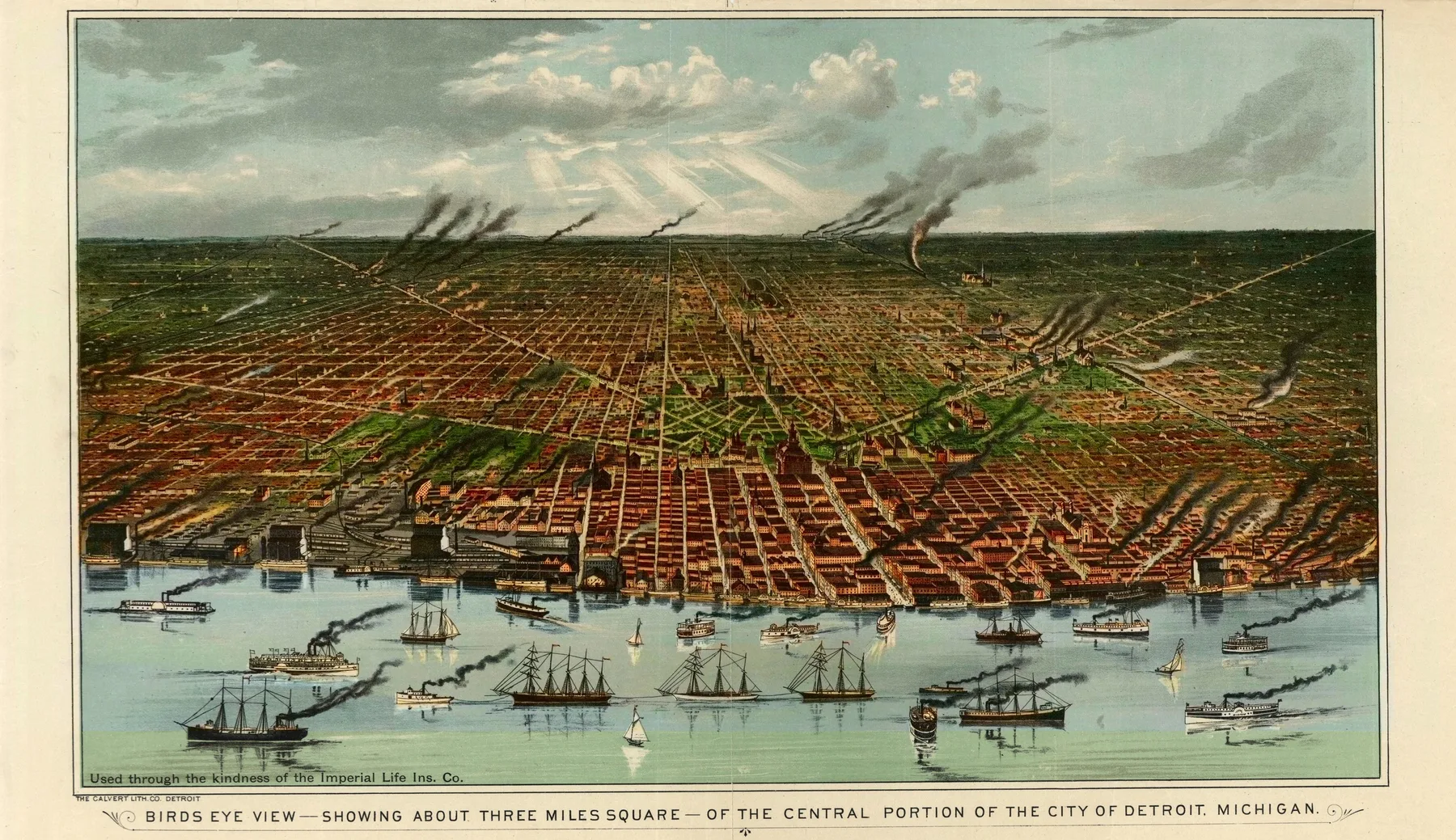
At the foot of Woodward Avenue, the river never let the street end in silence. Ferries eased off for Windsor and steamers pressed against the docks. Coal smoke hung above the public wharf. From the deck, Detroit did not read as a place waiting for its future. It read as a city already making things, loading them, and sending them out across the water.
By the 1890 census, Detroit had 205,876 residents, enough to rank fifteenth among American cities. The number matters because it fixes Detroit before the automobile rearranged every assumption about it. In the 1880s the city sat at the center of the stove trade. Detroit Historical Society records call it the nation’s stove manufacturing center by 1881, and its encyclopedia notes that firms such as Detroit Stove Works and Michigan Stove Company, with Peninsular beside them, made stove manufacturing Detroit’s leading industry in the late nineteenth century. That work belonged to foundries, pattern shops, machine rooms, and riverfront shipping. The clang came first. The motor came later.
The year 1889 also gave Detroit a new kind of civic confidence. The Hammond Building, the city’s first skyscraper, stood near completion at Griswold and Fort, a ten story block that people came to see because nothing in Michigan had yet risen quite that way. Detroit Historical Society notes that the building became both Detroit’s and Michigan’s first skyscraper, and its height gave the weather bureau a place to signal ships on the river. In the same political season, Hazen Pingree won the mayor’s race against the local machine and took office in 1890. He had entered politics as a shoe manufacturer, not as a reform theorist. That was part of the point. Detroit in 1889 trusted industrial men and engineers to give the city its next shape.
Calvert Lithographing Co. drew the sheet with that confidence in mind. The title states that it shows about three miles square of the central portion of Detroit, not the whole city, and the choice matters. The river occupies the foreground, crowded with ferry traffic, steamers, and sailing craft. Windsor sits across the water as part of the same working horizon. Inland, the grid runs back in long straight lines, while smoke plumes mark the industrial belt that made the waterfront worth drawing in the first place. Calvert did not try to flatter Detroit into a picturesque lake city. The company drew a border city that wanted to be read through commerce, traffic, and heat.
That is why the print stays in 1889. Detroit had begun to build upward and vote for reform, but it still introduced itself from the river, with ferry wakes below and factory smoke behind.
Themes
On the sheet
- Detroit River and Windsor, Ontario across the water
- Woodward Avenue grid
- The industrial waterfront
- Belle Isle in the river


