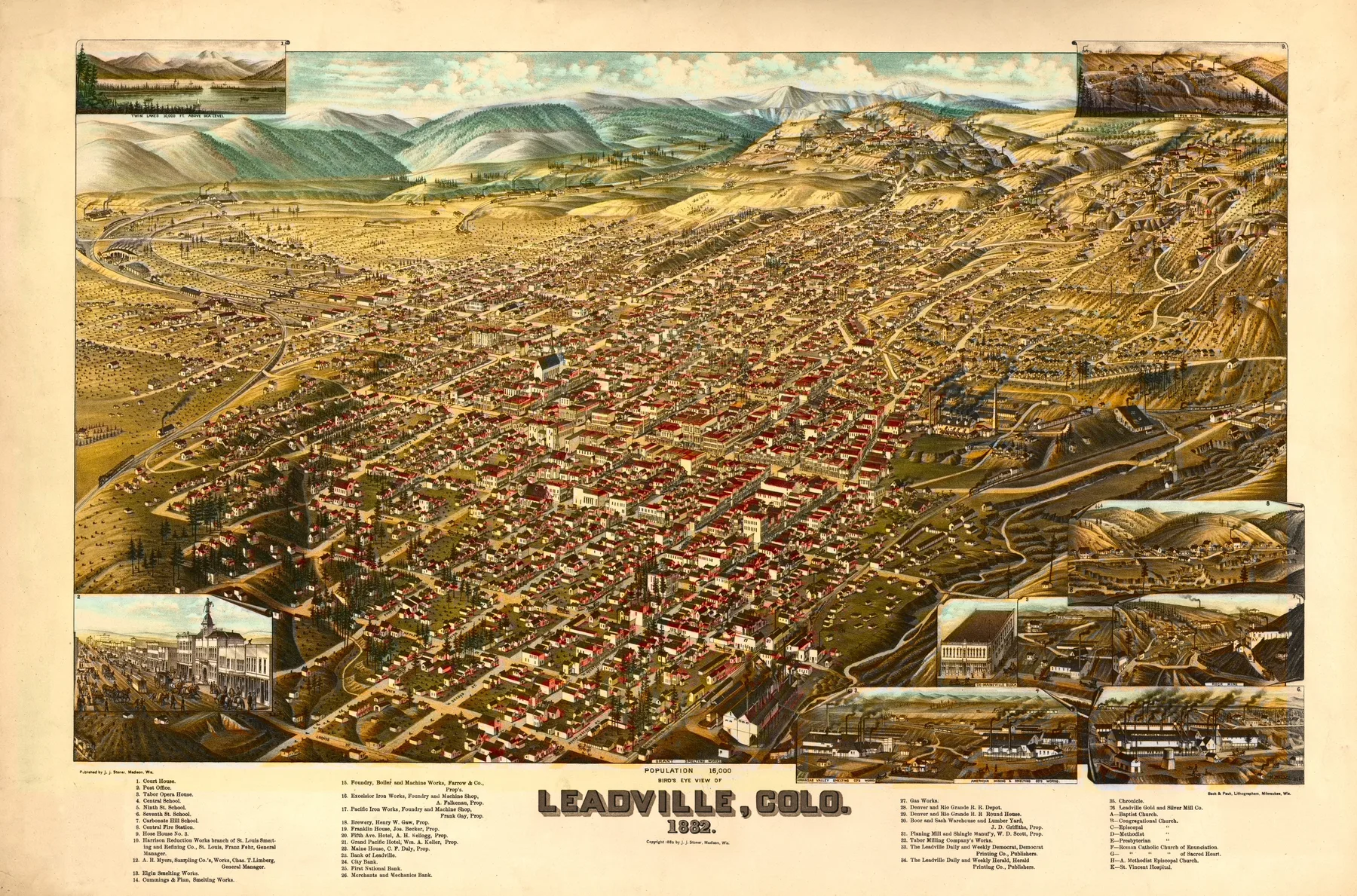
On Harrison Avenue, the air held coal smoke and ore dust. Wagons came down from the workings above town with loads for the smelters, and men who had spent the morning in shafts or assay offices crossed the same boardwalks as shopkeepers in dark coats. Leadville sat at 10,152 feet, high enough that every sound carried hard in the thin mountain air, but in 1882 the place did not feel remote. It felt crowded and in a hurry.
By the 1880 census, Leadville had 14,820 residents. That count marked the height of the town’s population, a reminder of how fast the silver boom had remade this valley. Yet the city in 1882 was not just a camp of miners and speculators. The National Park Service notes that by 1880 some 400 Jewish residents, many of them German immigrant merchants, had built a religious school and a web of institutions that included a Hebrew Benevolent Society and a B’nai B’rith lodge. That is not the detail most people expect from an American silver town above the timberline, but it tells you what sort of place Leadville had become. Fortunes from ore moved through clothing stores, groceries, hotels, and banks, and whole communities followed the money up the mountain.
Leadville also insisted on culture with the same force it brought to extraction. Horace Tabor built his opera house in 1879 in one hundred days, hauling materials over rough passes to a town that had existed in rough form a few years before. Its hall burned with seventy-two gas jets. On April 13, 1882, Oscar Wilde lectured there at the Tabor Opera House on Harrison Avenue. The fact sounds absurd until you place it in Leadville’s own terms. This was a city rich enough to want refinement on demand, and impatient enough to import it before the mud had left the streets.
Henry Wellge and J. J. Stoner drew the 1882 sheet as a place with civic ambition, not as a camp waiting to fold. The Library of Congress record notes an index to points of interest, and the print uses it to spread Leadville across the valley with the business blocks on Harrison Avenue set against the mining ground and reduction works that fed them. The Tabor Opera House belongs in that frame, but so do the gulches and the hard geometry of a town forced into order by profit. The artist did not trim away the workings that made the streets possible. He left the commercial spine and the extractive landscape in the same field of view.
That choice is the point of the map. Leadville wanted brick fronts and gaslight, with an opera house to prove it, but it also wanted the viewer to understand where the money came from. Wellge’s panorama lets the town present itself as both mountain city and mining machine, a place that had climbed above the clouds and still kept one boot in the ore.
Themes
On the sheet
- Harrison Avenue commercial strip
- Tabor Opera House
- Smelter row along the valley floor
- California Gulch mining district


